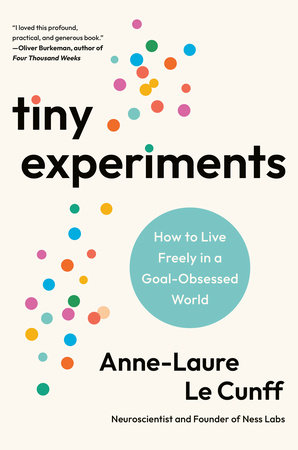
Tiny Experiments
Notes & Thoughts
Tiny Experiments
Tiny Experiments by Anne-Laure Le Cunff advocates for embracing curiosity and experimentation over traditional goal-setting. The book argues that we pursue the “ladder” of success and burn ourselves out with endless goals that relentlessly push the target further, while failing to allow for exploration, failure, and curiosity. Instead of rigid purposes and SMART goals, Le Cunff proposes the PACT framework—creating purposeful, actionable, continuous, and trackable experiments that focus on outputs rather than outcomes. The book emphasizes working with natural rhythms, practicing mindful productivity, reframing procrastination as exploration, and learning in public through community engagement.
Introduction
There are times when we must let ourselves slow down so we can gain better focus on what really matters. American psychiatrist Irvin Yalom proposes awakening experiences that shake us free of our routines and defenses. Le Cunff also references Joseph Campbell’s “The Hero with a Thousand Faces.”
At heart, we are adventurers who grow up exploring and asking questions. As we mature, we quit questioning and exploring, trying instead to be the one with the answers. Traditional goals support the pursuit of control and minimizing failure, preventing creativity, exploration, and new opportunities.
Part I: Commit to Curiosity
Chapter 1: Why Goal Setting is Broken
At heart, we are adventurers who grow up exploring and asking questions. As we grow up, we quit questioning and exploring and try to be the one with the answers. Because traditional goals support the pursuit of control and minimizing failure, they prevent creativity, exploration, and new opportunities.
SMART goals look to create an achievable timeline in a linear fashion for goals. However, most people get paralyzed by determining the next action to take. The traditional goal system breeds a competitive and unhappy culture where the “ideal” you is always in the future.
In the face of uncertainty, we often adopt one of three mindsets:
- Escapism
- Cynicism
- Perfectionism
Chapter 2: Escaping the Tyranny of Purpose
A focus on a “purpose” is a reductionist mindset where we limit our potential. Instead of a singular purpose, we can pursue and be lots of things. Cognitive scripts give us a planned expectation or reaction based on how things go. These give us confidence and avoid a feeling of uncertainty.
We are influenced by society to find a single thing we are good at and only pursue that one thing. When in reality, we can be and pursue many interests or curiosities that can open even more opportunities for us.
Capture your life through the eyes of a researcher to discover what interests you currently have. Make capture easy and low friction to make it more likely. What to capture:
- Insights
- Energy
- Mood
- Encounters
Chapter 3: A Pact to Turn Doubts into Experiments
When designing a personal experiment, focus on your outputs rather than your outcomes.
PACT:
- Purposeful
- Actionable
- Continuous
- Trackable (did you do? yes or no?)
“I will learn to code” - Flawed “I will code every day for a hundred days” - Great
Commit to a realistic number of repetitions of the experiment. Longer will mean more data but harder to maintain. Shorter will be easier to maintain with less data.
A Pact is not a habit. Habits are not time-bound and aim to get a specific result.
We love the idea of effort but would rather not put it in.
Pacts are repetition-bound experiments that focus on outputs rather than outcomes. They are meant to build enough experience in our experimental area to determine if we want to continue. Pacts are not habits, but can be used to determine if we want to start a habit.
Often when planning a project, we try to go for the more ambitious thinking that it will reward greater. When coming up with a Pact, think about the smallest version you can run. It will be easier to maintain, even on the worst days.
Part II: Practice Mindful Productivity
Chapter 4: A Deep Sense of Time
We relentlessly pursue productivity out of fear of the limited time we have available to us. Physical representations of time scare us because it makes time seem so limited. However, our perception of time is much less contained.
“Not all moments are created equal”
Our personal experiments do not need to be large. It can be tempting to go for the more ambitious experiments. However, it becomes more difficult to maintain the experiment. Also, time and productivity do not need to be maximized in order to have meaning. Our perception of time allows small or long moments to stretch or shrink. So the goal is not to get as much done as possible in a small amount of time, but to get meaningful things done in a mindful way.
Natural rhythms play a part in our energy throughout the day. I might look into the energy tracking apps again.
Sequential focus is different than time boxing. With sequential focus, we assess our current state of mind and energy and ask what is the most sensible task to handle right now.
Kairos rituals are tiny rituals that cue our bodies and minds into mindful productivity. Each person can have their own. Wonder what mine should be?
Natural rhythms play an important role in our abilities to be productive. We need to become aware of our energy. We then need to lean into that energy when working to accomplish our more energy-necessary tasks when we are at a peak. Don’t be afraid to take breaks to get into better headspace.
Managing Your Experiments
Procrastination is not always bad. Sometimes we need to reframe. Don’t punish, explore instead:
- Are we excited by the task/project?
- Is the task/project the wisest approach?
- Are we capable of completing it?
- Embrace imperfection
- Awareness of your perfection tendencies
- Allow imperfect to focus on specifics
- We cannot do everything
Iterate:
- Make small adjustments
- Reflection is key to avoid repeats
- Plus: what’s in your next system
- Positives that happened
- Negatives that happened
- Future-facing changes or next actions
Experiment complete. What now?
Persist:
- The experiment is going well and you want to continue
Pause:
- The experiment did not go well or circumstances have changed
- Pause, either indefinitely or temporarily
Pivot:
- Adjust but loop to next step
Managing obstacles:
- Accept the obstacle
- Recognize internal feelings
- Adjust: How to move forward?
Community Flow:
When we work with others we can find flow. Communities offer access to more knowledge:
- Communities can be online
- Explore online communities
- Learning in public:
- Unpolished, maybe even incorrect
- Iterate and grow
- Accept feedback, hive mind thinking
- Give back, answer others learning publicly
- Generative loops of iterative:
- Grow, learn, fail, repeat
- Sometimes our successes come from unexpected places
- Use your knowledge to help others
Key Takeaways
- Embrace curiosity over rigid goals - Allow yourself to explore multiple interests rather than forcing yourself into a single purpose
- Use the PACT framework for designing personal experiments that focus on outputs, not outcomes
- Work with your natural rhythms - Pay attention to your energy levels and schedule important work accordingly
- Start small - The smallest version of an experiment is easier to maintain and provides valuable learning
- Make capture easy - Track insights, energy, mood, and encounters to understand what truly interests you
- Practice sequential focus - Choose tasks based on your current state of mind and energy, not arbitrary time blocks
- Reframe procrastination - Sometimes procrastination signals a need to explore rather than punish yourself
- Iterate through reflection - Use reflection to identify what worked, what didn’t, and what to change
- Learn in public - Share your unpolished work, accept feedback, and grow through community interaction
- Persist, Pause, or Pivot - After an experiment, consciously choose whether to continue, pause, or adjust your approach
References
- Le Cunff, A.-L. Tiny Experiments