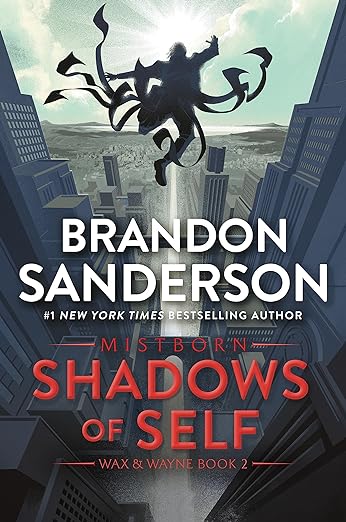
Shadows of Self
Read: April 2025
Notes & Thoughts
Shadows of Self
Shadows of Self is the second book in Brandon Sanderson’s Wax and Wayne series, deepening the mystery and political intrigue while exploring themes of identity, justice, and the consequences of past actions. The book follows Wax and Wayne as they investigate a series of murders that seem to be connected to the city’s political unrest.
Key Concepts
1. Identity and the Self
The book explores what makes a person who they are, particularly through the character of MeLaan, a kandra who can change her appearance at will. This raises questions about whether identity is tied to physical form or something deeper.
2. Justice vs. Revenge
Wax faces situations where the law and his sense of justice conflict, forcing him to question whether some actions can be justified even if they’re technically illegal.
3. The Weight of History
The book shows how the past continues to influence the present, with characters dealing with the consequences of decisions made generations ago.
Plot Development
The Murder Investigation
The central mystery involves:
- Political assassinations - Targeting key figures in the city’s government
- Kandra involvement - The shapeshifting kandra play a crucial role
- Social unrest - The working class is becoming increasingly dissatisfied
- Personal stakes - Wax’s past connections to the victims
Character Arcs
Wax
Wax’s journey involves:
- Facing his past - Confronting decisions he made as a lawman
- Balancing multiple roles - Being a husband, lawman, and noble
- Questioning his methods - Wondering if his approach to justice is still valid
Wayne
Wayne’s development shows:
- Growing maturity - Taking his abilities more seriously
- Deeper understanding - Learning to see beyond surface appearances
- Loyalty tested - Supporting Wax even when he disagrees with his choices
Worldbuilding Expansion
Kandra Society
The book reveals more about the kandra:
- Their role in society - Serving as trusted advisors and bodyguards
- Their limitations - Rules they must follow and abilities they possess
- Their perspective - How they view humans and their own existence
Political Structure
The book explores:
- The governor’s role - How the city is actually governed
- Class tensions - The growing divide between rich and poor
- The role of religion - How faith influences political decisions
Themes and Philosophy
The Nature of Justice
The book questions whether justice is:
- Absolute - Following the letter of the law regardless of circumstances
- Relative - Adapting to the specific situation and context
- Personal - Based on individual moral codes
Change and Adaptation
Characters must adapt to:
- New social realities - The changing political landscape
- Personal growth - Their own evolving understanding of their roles
- External pressures - Forces beyond their control
The Cost of Secrets
The book shows how keeping secrets can:
- Protect people - Sometimes necessary for safety
- Harm relationships - Creating distance between people
- Lead to misunderstandings - Causing conflicts that could be avoided
Writing Craft
Mystery Elements
Sanderson weaves together:
- Multiple plot threads - Political intrigue, personal drama, and supernatural elements
- Red herrings - False leads that keep readers guessing
- Satisfying reveals - Answers that make sense in hindsight
Character Development
The book shows character growth through:
- Difficult choices - Characters must make hard decisions
- Relationship dynamics - How characters interact and change each other
- Internal conflicts - Characters struggling with their own beliefs and desires
Connections to Other Ideas
The theme of identity and how it can change connects to [[digital-garden-philosophy]], where our understanding of ideas evolves over time.
The exploration of justice and morality relates to [[principles-and-beliefs]] and how we maintain our values in complex situations.
Favorite Quotes
“The best liars are those who tell the truth most of the time.”
“Sometimes, you have to destroy something to save it.”
“Justice is not always found in the law.”
Related Notes
- [[networked-thought]] - How complex systems can hide important information
- [[systems-should-flex-to-life]] - The need for systems to adapt to changing circumstances
Further Reading
Continue the Wax and Wayne series with:
- The Bands of Mourning (Wax and Wayne Book 3)
- The Lost Metal (Wax and Wayne Book 4)
Series Context
This book deepens the political and social complexity of the Wax and Wayne series while maintaining the fast-paced action and mystery elements. It shows how Sanderson can evolve his storytelling while keeping the core elements that make his books engaging.
The book also sets up important plot threads that will be resolved in the remaining books of the series, showing Sanderson’s skill at long-term story planning.